
Small and mid-sized business owners often reach a frustrating moment when demand rises but time, cash flow, and capacity refuse to stretch with it. These business growth challenges can turn daily decisions into tradeoffs, service slips, teams burn out, and competitors feel closer than ever. Innovation in business isn’t a luxury reserved for giants; it’s a practical way to build steadier operations and clearer focus. With the right digital transformation benefits, SMBs can create a durable competitive advantage for SMBs.
Pick 7 Digital Upgrades That Pay Off Across Your Business
Growth pain has a way of revealing what matters most: time, cash flow, and trust. These seven digital upgrades are practical levers you can pull, one at a time, to reduce friction now and build a business that lasts.
- Move your core files and systems to the cloud (on purpose): Start with email, file storage, and accounting, then migrate one operational system at a time (inventory, scheduling, CRM). Cloud computing for SMBs reduces “heroic” IT moments because updates, backups, and access controls become repeatable, not improvisational. Use a 30-day pilot with 3–5 users and set success measures like fewer support tickets, faster close-of-month, or fewer duplicate files.
- Define one decision you’ll improve with analytics: Big data analytics benefits don’t come from collecting everything, they come from answering one question reliably. Define objectives to pick a single metric you’ll review weekly (on-time delivery rate, repeat purchases, quote-to-close time). Then standardize how that data is captured so the number becomes trustworthy enough to guide staffing, pricing, and inventory.
- Automate one process that steals hours every week: Choose a workflow with clear start/finish, invoice reminders, lead follow-ups, purchase approvals, or new-hire onboarding. Map the steps on one page, eliminate what you can, then automate what remains with rules like “if X happens, notify Y within 5 minutes.” Business process automation pays off fast because it prevents dropped handoffs and frees your best people to do the work only humans can do.
- Strengthen digital marketing with a simple cadence and measurement: Pick one primary channel (email, search, or social) and commit to a 90-day rhythm: one helpful message per week, one offer per month, one performance review per month. Tie every campaign to a goal (leads, bookings, repeat orders) and track it with basic tags so you can double down on what works. Treat your content as an asset you’re building for your future customers, not just a promotion you’re running.
- Build a “minimum lovable” mobile experience for customers: Mobile app development doesn’t have to start with a complex app; start with one job customers struggle to do quickly, reordering, booking, checking status, accessing support, or receiving alerts. Pilot with your best customers first, and design for speed over features. When mobile removes waiting and uncertainty, it quietly increases loyalty.
- Equip your team for remote work with rules, not just tools: Remote work technologies matter most when paired with clear agreements: where documents live, how decisions are documented, and what “done” looks like. Create one shared dashboard for priorities, one channel for urgent issues, and a weekly 30-minute sync that ends with owners and deadlines. This reduces rework and protects your culture as you grow across locations and schedules.
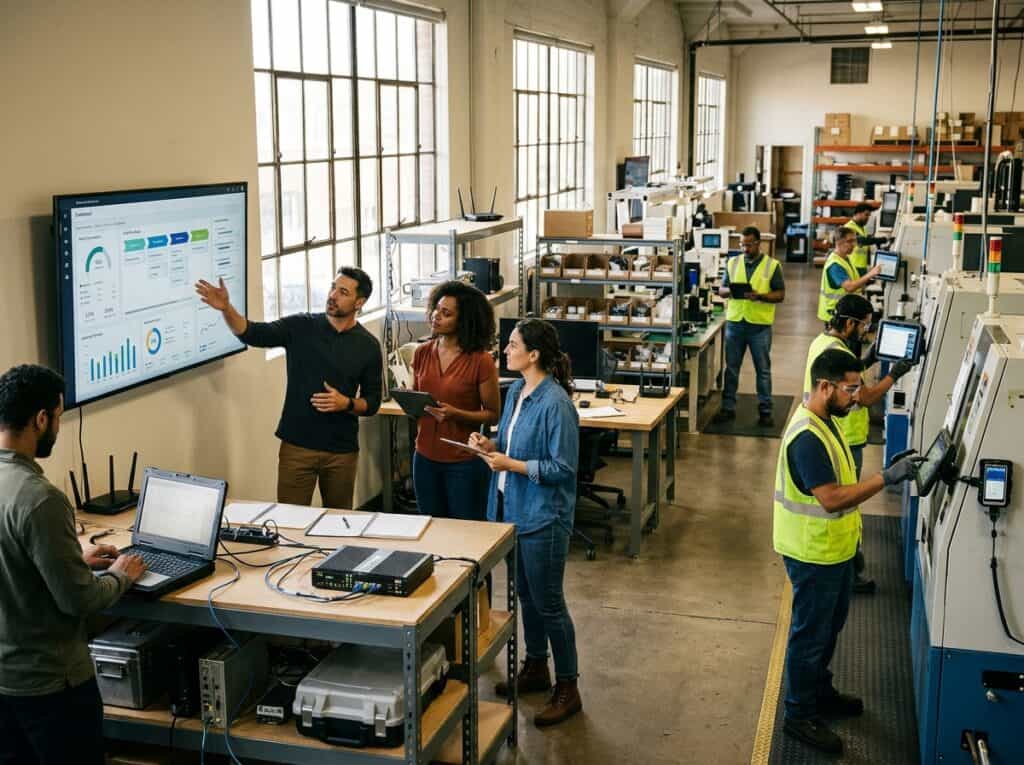
- Instrument the work where it happens with simple sensors and dashboards: If you make, move, or service physical things, start capturing real-world signals, temperature, vibration, run time, cycle counts, or location, on your most critical asset. Use that data to spot downtime patterns, prevent failures, and schedule maintenance before problems become emergencies. This is the bridge from digital efficiency to smarter operations on the floor, where small visibility gains can compound into major capacity wins.
Build a Smarter Factory Floor With Rugged Edge Technology
The same digital upgrades that strengthen your back office can also unlock new momentum where value is physically made, on the factory floor. Smart manufacturing solutions streamline operations by capturing industrial IoT data at the source and turning it into clear, real-time visibility into throughput, downtime, and quality.
With factory-floor automation informed by that live data, teams can reduce bottlenecks, improve consistency, and make faster decisions without waiting for end-of-shift reports. Over time, the gains compound: once data capture and monitoring are in place, you have a scalable foundation for innovation that can keep raising efficiency even as production demands change.
One practical way to enable this in harsh, always-on environments is to equip your operation with industrial-grade edge computing hardware, built to support AI, IoT, machine vision, and data analytics, so you can optimize real-time monitoring, automation, and operational efficiency with industrial computing for manufacturing.
A Simple Rhythm for Innovation That Sticks
This repeatable workflow turns “we should improve this” into a steady cadence of choosing the right tools, bringing people along, and proving results with simple measures. It matters because small teams do not need more ideas, they need a system that protects focus and keeps momentum when the day gets busy.
| Stage | Action | Goal |
| Clarify the target | Name one constraint and one customer impact to improve | A focused problem worth solving |
| Choose the smallest test | Pick one tool change and define the trial scope | Low-risk proof of value |
| Prepare the people | Assign owners, train users, update the routine | Confident use and fewer workarounds |
| Implement and stabilize | Roll out, document steps, support issues fast | Reliable day-to-day performance |
| Measure and learn | Track 3 KPIs, review weekly, note surprises | Clear impact and next hypotheses |
| Standardize and scale | Lock in what works, then expand to next area | Repeatable gains over time |
This loop keeps your attention on outcomes, not features, and it reduces the chance that improvements fade after launch. It also reflects why the SMB IT spending market keeps growing, since businesses tend to invest when they can connect change to results.
Smart Innovation Questions SMB Owners Ask
Q: How do I justify the cost of new digital tools on a tight budget?
A: Tie every purchase to one measurable outcome like faster turnaround, fewer errors, or higher repeat sales. Start with a short pilot and set a “keep or kill” date so you are buying proof, not promises. Many tools have become more accessible as the increase in affordability keeps lowering the barrier to competing well.
Q: What can we do to protect customer data without a full IT department?
A: Begin with fundamentals: strong access control, patched devices, and reliable malware protection. A clear baseline like Cyber Essentials certification can help you focus on the few controls that prevent the most common problems. Keep it simple, documented, and reviewed quarterly.
Q: How do I handle employees who resist new technology?
A: Assume the resistance is often uncertainty, not stubbornness, and train for confidence. Surveys show 60% of employees worry they will not understand new tech, so build practice time into the schedule and celebrate small wins. Choose one champion per role to coach peers.
Q: When should we build custom software versus buy an off-the-shelf tool?
A: Buy when the work is common across your industry and you need speed. Build only when the process is your competitive edge and you can support it long term. If you cannot explain the unique advantage in one sentence, start with buying.
Q: How do I choose the right solution when everything looks similar?
A: Decide based on fit, not features: ease of use, integration with what you already run, and clear reporting on the metric you care about. Ask for a trial that uses your real workflow and real data, then score it with a simple checklist. The right tool feels calm in daily use.
Turn Smart Innovation Into Sustainable Small-Business Growth and Legacy
Running a small business often means choosing between today’s demands and the upgrades that will keep tomorrow possible. The way through is an entrepreneurial mindset for innovation, making deliberate, sustainable growth strategies part of how decisions get made, not a side project. When that becomes the norm, future-proofing SMBs stops feeling like a gamble, and long-term innovation impact shows up in steadier operations, stronger customer trust, and a clearer path to business legacy through technology. Innovation isn’t a project; it’s how a small business earns its future.

